
Islamic stories
Zain of the Valley of Certainty: A Story about Trusting God
In this imagined Islamic adventure, twelve-year-old Zain combines trust in God, knowledge, and kindness to animals on a journey to restore his village’s water.
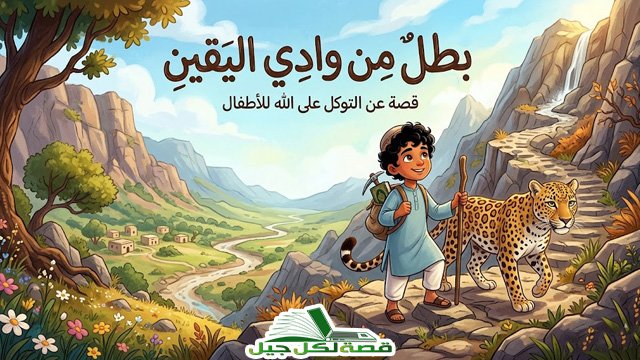
Welcome to Qissaflow. Looking for an exciting bedtime story about meaningful values? This original, imagined adventure explores trust in God through the journey of brave young Zain in the Valley of Certainty. It brings together faith, thoughtful action, and compassion for animals. The characters and events are fictional; the identified Quranic passages and religious teachings are distinct from the invented narrative.
Read next: Prophet Ibrahim and Nimrod: A Retelling for Children.
A Children's Story about Trusting God
Once upon a time, long ago, let us begin by remembering God and sending peace and blessings upon His chosen Prophet, Muhammad ibn Abdullah, the bearer of good news and a mercy to the worlds.
Come closer, my dear children, bright as spring flowers and evening stars. Sit around and open your hearts as well as your ears. Today's story is an adventure about faith, reliance on God, and taking practical steps to meet a challenge.
Its hero is a young boy with a courageous heart and a thoughtful mind. Are you ready to travel to the Valley of Certainty? In God's name, let us begin, placing our trust in Him.
In a beautiful place where high mountains touched the clouds stood a peaceful village called the Valley of Certainty. God had blessed it with a clear spring flowing from nearby Mercy Mountain. A lovely waterfall brought water for crops, drinking, and washing before prayer.
The villagers lived gratefully, praising God in good times and difficult ones. Affection and cooperation united them, like the parts of a well-built structure supporting one another.
Our hero, twelve-year-old Zain, had bright, intelligent eyes. His strengths were not merely physical: he was thoughtful and deeply faithful. He had memorized many passages of the Quran and reflected on their meaning. His wise grandfather, Hajj Saleh, taught him that contemplating God's creation was an act of worship and that nature was a trust placed in our care.
Each morning, after praying at the mosque with his father, Zain sat beneath an olive tree with his grandfather to watch the sunrise.
“Look at this wonderful universe,” Grandfather Saleh said. “Consider how God brings clouds and life-giving rain to dry earth. The Quran says, in meaning, ‘We made every living thing from water’. Everything follows an order established by the Creator.”
“Glory be to God, Grandfather! But how does water keep coming from that high mountain to our village?”
“Through the natural processes God has created. Mountains can store rain and melted snow in cracks and underground spaces, releasing it through springs. Learning how these processes work helps us care for the earth and preserve its blessings.”
Zain listened closely and wrote his observations in a little notebook. He enjoyed simple geography books and learned to find directions by the stars, tie ropes, and recognize useful plants. He hoped to become someone who could serve his community and faith.
Peaceful days passed until a sudden change tested the villagers' patience and belief.
One hot summer morning, they woke to a strange silence. The familiar waterfall had stopped. They hurried outside and found the spring dry, with only a few drops disappearing into the thirsty ground.
Fear spread. Crops would wither, livestock would thirst, and families would have no drinking water. The villagers gathered in the mosque courtyard to discuss the crisis.
“Our water has stopped,” the mayor said. “The small wells may supply us for only a few weeks. We must use it carefully, but we must also discover why the spring suddenly failed.”
One frightened man spoke. “Perhaps the mountain is angry because we did not celebrate the harvest properly. Or perhaps evil spirits have trapped the water!”
Sheikh Abdul Rahman, the mosque's imam, rose among them, his face solemn.
“Wait, my brother. Seek God's forgiveness. Mountains do not become angry, and spirits do not control our fate. The Quran teaches, in meaning, ‘No calamity occurs on earth or within yourselves except that it is recorded before We bring it into being’. We should respond patiently, trust God, and investigate the physical cause so we can address it through effort.”
“You are right,” said the mayor. “But who will climb Mercy Mountain in this heat? The paths are rough, and predators may be nearby. Many of our young people are away or busy, and those here do not know the mountain well.”
Zain stepped through the crowd and stood before the mayor and imam. He was small, but his stance was brave.
“Peace and God's mercy be upon you,” he said. “Grandfather has taught me the mountain paths, and I have studied its watercourses. A blockage in the high cave, perhaps from a rockfall, could explain the sudden loss of water. I am willing to climb and investigate.”
The blacksmith smiled sympathetically. “You are brave, Zain, and we all care about you. But the mountain is dangerous. This is work for strong, experienced adults.”
“Strength is not only in muscles,” Zain answered. “Faith, knowledge, and careful thinking matter too. Our religion teaches us to take practical precautions. I shall carry supplies and be careful, while trusting God with my life.”
Grandfather Saleh looked at him with proud, tearful eyes and placed a hand on his shoulder.
“I believe in this boy,” he told the mayor. “I have taught him what I know. He is stronger than he looks. Let him go with trust in God, and we shall pray for him.”
After some hesitation, the mayor agreed, and the whole village helped prepare Zain for the journey.
The next dawn, after congregational prayer, Zain stood outside his home to say goodbye. His mother packed a sturdy leather bag with dried dates, barley bread, a waterskin, bandages, and a small Quran.
With tears in her eyes, she said, “I entrust you to God, whose care never fails. Remember Him wherever you are. Keep your prayers and speak His remembrance often.”
His father gave him a strong walking stick, a small pickaxe, and climbing rope. “Be careful. Think before each step. Put your trust in the Ever-Living, who never dies.”
“May God reward you both,” Zain said. “Do not worry. I shall do my best and, God willing, return with good news.”
He set off as the first golden sunlight reached Mercy Mountain. The rocky paths twisted upward through fresh morning air and birdsong. Whenever he tired, he repeated, “There is no power or strength except through God. O God, nothing is easy except what You make easy.”
He climbed for two days, sleeping in sheltered hollows and carefully rationing food and water. On the third day, he reached Echo Valley, a narrow passage between sharp-sided mountains where sounds repeated again and again.
As he crossed cautiously, he heard something unusual: not wind or birds, but the groan of a creature in pain.
He stopped to listen. His Islamic upbringing had taught him compassion for living creatures. Remembering the Prophet's teaching that caring for a living creature brings reward, he decided to find the sound, even if it delayed him.
Behind a large rock lay a wild cat, described in this tale as an Arabian mountain leopard. Its hind leg was trapped between fallen boulders. Breathing with difficulty, it watched Zain with frightened, painful eyes.
Zain kept a safe distance. A predator could be dangerous. “Should I leave it and go on?” he wondered. “No. My faith teaches mercy. Perhaps there is a reason I found it here.”
He spoke softly, not because he thought it understood his words, but because a calm voice might help reassure it.
“Do not be afraid, beautiful creature. I shall not hurt you. In God's name, I will try to help.”
He took out his tools and used the long stick as a lever, as his grandfather had taught him. He placed one end beneath the boulder, set a smaller stone as a fulcrum, and pressed his weight onto the other end.
The effort was exhausting. Sweat ran down his forehead as he recited Ayat al-Kursi, seeking God's help. Slowly, the boulder lifted a little, and the leopard pulled its leg free.
The rock dropped heavily. Zain stepped back, ready for the animal's reaction. It did not attack. Limping, it gave him a long look that seemed grateful, then sat and licked its wound.
Zain poured water into a hollow in a nearby rock for it to drink. Then he tossed a clean cloth close enough for it to use as a barrier against the dirt.
“Praise be to God, who helped me free you,” he said. “Now I must continue and help my village.”
He shouldered his bag and climbed on. To his amazement, the leopard followed at a distance, limping slightly, as though choosing to accompany him. Zain welcomed its company and understood it as God's kindness. He remembered the Quran's teaching that animals, too, are communities.
On the fourth day, he faced his greatest challenge. At last he reached Spring Cave, the source of the village waterfall. What he found stopped him in astonishment.
His guess had been right. A great landslide had brought rocks and earth down from the summit, completely blocking the cave. The water had no outlet.
He approached the rubble and pressed his ear against the cold stone. He could hear water roaring behind the blockage, trapped under growing pressure.
He tried shifting stones by hand, but they were far too heavy. His small pickaxe struck the hard rock without making much difference.
Hours passed. As the sun sank, Zain sat exhausted and discouraged. The boulders were enormous, he was young, and his tools were simple. Should he go home and say the task was impossible? What would happen to the thirsty village?
He remembered his mother's reassurance that God was with him, and the Quranic question, in meaning: “Who answers the distressed when they call upon Him and removes their hardship?”
Using a little of his remaining water, he washed for prayer, faced the qiblah, and prayed two units. In prostration, he wept and asked for help.
“My Lord, Ever-Living and Sustainer, nothing on earth or in heaven is beyond You. I have done what I can and come this far, but my strength is failing. Help us and the people of my village. Do not leave us without water. Grant me an idea or help from You, for You have power over all things.”
He remained in prostration for a long time. When he finished praying, an unusual peace filled his heart. He felt that God had heard him and that relief was near.
After dark, he made a little fire for warmth and watched the stars. The leopard rested nearby, keeping watch while the boy slept.
At dawn, Zain woke with renewed energy. He studied the blockage again, looking beyond the largest boulders for a weak point.
His studies and careful observation helped him notice a medium-sized rock near the bottom, surrounded by wet clay. It supported several larger stones. If it shifted or broke, the pressure behind the blockage might bring the whole pile down.
But how could he break such hard stone?
He remembered the blacksmith's lesson about materials expanding when heated and contracting when cooled. An idea flashed into his mind.
He gathered dry wood and branches around the lower rock, lit a fire, and let it burn for hours until the stone became extremely hot.
Watching him work, the leopard began clawing at the surrounding wet earth, as though following its own instinct to dig. This loosened the rock further. Zain marveled at the help the creature was giving him.
When the rock was intensely hot, he signaled the leopard to move back. Taking the waterskin containing the last cold water he had saved, he stood aside, spoke God's name, and poured it over the heated stone.
Listen to what happened next in the story.
The sudden cooling stressed the hot rock. A loud crack rang out—bang!—and the supporting stone split in two.
The rubble above lost its balance. Earth crumbled, and the larger rocks began to slide.
“Move away!” Zain cried to the leopard. “Run!”
He rushed from the cave and climbed to a high, sheltered rock. The leopard followed.
Moments later came a great roar, not from an animal, but from released water. Under its pressure, the blockage collapsed. The waterfall surged out, sweeping away broken rock and soil and pouring down its old channel toward the Valley of Certainty.
The sight was magnificent. Clear water, a blessing from God, was returning to revive the land.
Overcome with joy, Zain knelt on the high rock and bowed in gratitude, smiling through his tears.
“Praise be to God, through whose blessing good things are completed. Praise be to God, who heard my prayer.”
He looked at the leopard, standing proudly above the rushing water.
“Thank you, my friend. You have been a wonderful companion. Return freely to your mountains. May God bless your life.”
The leopard dipped its head as though saying goodbye, then turned and disappeared among the high rocks.
Zain began the journey home. It felt easier now: the water guided him, and happiness lightened his tired steps.
Meanwhile, the villagers were close to despair. Wells had dried up, crops were yellowing, and everyone had gathered at the mosque to pray for rain.
Suddenly, the children heard a familiar sound in the distance.
“Listen!” a child cried. “Water! The waterfall has returned!”
Everyone ran toward the channel in disbelief. Fresh water filled the irrigation ditches, washed the stones, and brought life wherever it flowed. “God is greatest! Praise be to God!” they cried, bowing in gratitude.
Then a small figure appeared among the descending rocks. His clothes were dusty and his face tired, but his smile seemed to light the valley. It was Zain.
His parents ran to embrace him, both weeping.
“Praise be to God for your safe return, my dearest boy,” his mother said.
The mayor lifted him onto his shoulders. “Look at our hero! Through trust in God, courage, and knowledge, he helped save our village. Faith and hard work have brought good.”
“May God bless you and those who raised you,” Sheikh Abdul Rahman said. “You put belief into practice: trusting God, using your mind, and taking practical action.”
From then on, the villagers called him Zain the Wise. He grew up to study engineering and earth science, building waterworks and regulating the village supply so that, God willing, it would continue to flow.
The villagers never forgot that superstition cannot solve a problem. They learned to study the natural processes God has created, to read, work, and trust Him, and to show kindness to vulnerable people and animals.
You may also enjoy: Prophet Adam in Paradise: A Retelling for Children.
Our imagined adventure ends here, dear children. Have you seen how a young person can achieve something remarkable through faith, knowledge, and determination? May God protect you, bring happiness to your parents through you, and help you grow into people who serve their community with kindness, like Zain.