
Fairy tales & fables
The Fox and the Drum: An Expanded Fable about Appearances
Hungry Makhalib hears a tremendous sound and imagines an enormous feast. Follow his discovery in this expanded fable about greed, assumptions, and empty noise.
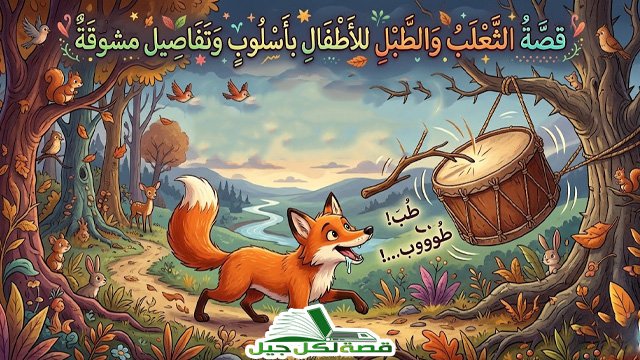
The Fox and the Drum is a fable associated with Kalila and Dimna. Although the traditional tale is brief, this expanded retelling develops its setting and the fox's inner struggle in a more detailed literary adventure.
Join Qissaflow in the Forgotten Forest, where appearances blur with reality and hunger threatens to overwhelm good judgment.
The Fox and the Drum
In a vast woodland known as the Great Forest lived a fox called Makhalib. Famous for cunning and catching prey with little effort, he had glossy orange fur like sunset, a magnificent bushy tail, and sharp eyes that seldom missed a target.
For years, he lived comfortably. He knew every rabbit burrow, bird's nest, and deer trail. But nothing lasts forever. One year, rain failed, springs dried up, and green grass became windblown straw. Birds abandoned their nests, while deer and rabbits traveled to more fertile forests.
Weeks passed, and hunger weakened those who remained. Makhalib's fur lost its shine, his ribs showed, and his proud tail hung in dull strands. Each morning, he dragged his tired paws out in search of anything: an insect, a slow lizard, or scraps left by a tiger. The forest offered nothing.
One cold autumn day, he stood on a little hill overlooking bare trees like ghosts with raised arms. Weakly, he sighed and spoke to himself.
“Where have my good days gone? Shall I starve in the forest where everyone once called me the master of cunning? My stomach aches, and dizziness clouds my sight. I must find something—anything—if I am to see another sunrise.”
He decided to leave his familiar territory for the rugged eastern woods known as the Forgotten Forest. Animals avoided its harsh ground and thorny trees, but hunger left him feeling he had little choice.
Dry leaves crackled beneath his paws, disturbing the deep silence. Cold autumn wind howled among the trunks like hungry wolves, striking his face and slipping through his thinning fur.
He walked for hours. A large grasshopper sprang before him, but his slow, weakened body could not catch it. It vanished among the rocks. The fox sank to his knees, closed his eyes, and felt despair taking hold.
“I am finished,” he whispered. “I have no strength for another step.”
Yet deep in those woods, something unusual awaited him, something made not by nature, but by humans.
The previous spring, a king's great hunting procession had passed nearby. Guards, servants, and musicians accompanied him. Drums and horns frightened animals from hiding so the hunters could surround them.
One night, a sudden thunderstorm toppled trees and scattered horses. Amid the confusion, a huge drum fell from a camel. Used to signal the army's movements, it was built from strong oak and covered with thick, tightly stretched wild-bull hide.
The procession fled, leaving it behind. Shrubs grew around it, and a curved, dry branch hung above. When strong wind blew, the branch swung against the taut hide, producing a deep, thunderous sound that echoed through the deserted valley.
Now Makhalib lay on the ground, overcome by despair. A strong gust whistled through the trees. Suddenly, an enormous, terrifying sound broke the silence.
“Boom… boom… BOOM!”
The fox slowly opened his eyes, frightened almost beyond breath. He had never heard anything so powerful. Was it an earthquake? Some legendary beast waking from sleep?
Another gust came, and the sound returned, louder and clearer.
“Boom… BOOM… boom!”
Fear gave his exhausted body a sudden burst of energy. He sprang up and hid behind a great tree trunk, looking in every direction for the source.
Two instincts struggled within him. One urged him to flee: anything with such a voice must be enormous, able to crush a thin fox with one blow. But hunger whispered something different.
“Wait, Makhalib. You are the master of cunning. Will you run before seeing it? Think! A creature with such a powerful voice must be huge. And a huge creature must be full of fresh meat and fat. What if this is the feast I have been hoping for?”
Hunger overcame fear, and greed clouded his judgment. He decided to risk everything for the imagined meal. Keeping close to the ground, he crept forward, using all his old skills in concealment.
Step by step, he approached. Each gust moved the branch against the drum, and every boom helped him find the direction.
At last, he reached a thorn-covered slope and looked down. Among the tangled trees lay an astonishing sight.
A huge round shape had no head, tail, or legs. To him, it looked like a great mass of meat beneath smooth, stretched skin, held among two trees. Whenever the wind stirred, a branch struck it and made that tremendous noise.
His eyes widened and his mouth watered. His hungry imagination turned the object into a rare, fat animal with no legs to flee or teeth to fight: a vast balloon of meat waiting to be eaten.
“What a miracle!” he whispered, suddenly lively. “Patience really does bring relief. Look at its size! That tight skin must hold a mountain of fat. It could feed me for months, perhaps a year. I shall be strong again and regain my place in the forest!”
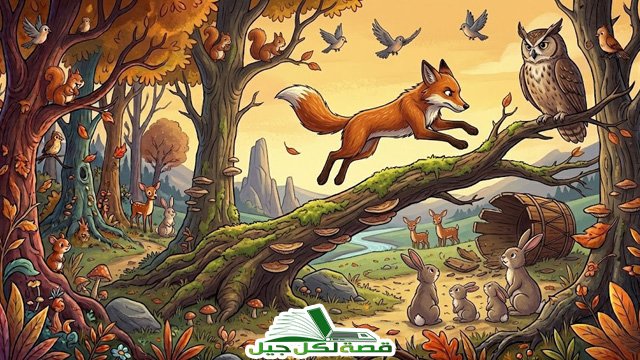
Unable to wait, he gathered his remaining energy, stepped back, tightened his hind legs, and launched himself through the air.
He cleared the thorns and flew toward the supposed beast. Opening his jaws, he thrust teeth and claws into its stretched skin.
“Cra-a-ack!”
A violent ripping sound rang through the woods. His teeth and claws tore the drumhead. His head and part of his body broke through into the hollow wooden drum, and both fox and drum fell and rolled across the ground.
For a few moments, he struggled inside, snapping at the air and searching for the warm meat and rich fat he had imagined.
But there was nothing.
No taste of blood. No smell of meat.
With difficulty, he pushed his head through the torn opening. Dust covered his face. Confused, he looked around, then into the thing he had attacked.
It was hollow. Completely empty.
Only a cylinder of dry wood covered with hide, containing air, a musty smell, and a few cobwebs.
Makhalib sat beside the ruined drum, now silent. Some claws had broken against the wood, and his teeth ached.
Yet physical pain troubled him less than bitter disappointment and shame. How had the supposedly clever fox been fooled by an empty sound and a misleading appearance? Why had hunger and greed silenced his judgment?
He sighed painfully, raised his head, and spoke in a sorrowful voice.
“How humiliating, to struggle with air and bite wood! I thought such size and such a mighty voice must conceal a wonderful treasure. Instead, I have learned a painful truth.”
He paused, looked at the empty drum, and continued.
“The largest, loudest things may be the emptiest within. A great size does not prove value, and a booming voice does not prove strength or wealth. Sometimes all that noise comes from having nothing inside.”
He shook dust from his dull coat. The effort had made him hungrier, but he felt richer in hard-earned wisdom. Turning from the broken drum, he walked slowly and more thoughtfully in search of something real, leaving the noise and illusion behind.
Read next: The Hare and the Tortoise.
Lessons from The Fox and the Drum
This fable offers ideas that remain relevant in many situations:
- Appearances can mislead. Size and an impressive surface do not reveal what something truly contains, just as the tight drumhead concealed empty space.
- Loudness does not prove importance. Hollow objects can make enormous noise. Similarly, many words and much shouting do not necessarily mean thoughtful action.
- Greed can cloud the mind. Hunger and desire made the fox rush past his usual good judgment. Calm reasoning helps us test our assumptions.
- Look beyond the surface. Seek the substance and reality of things rather than letting outward appearances excite your hopes.