
Bedtime stories
Five Bedtime Stories for Seven-Year-Olds about Friendship and Fairness
Read five tales about a dog and rooster, a lost bone, a bundle of sticks, a stuck cart, and Rabah’s golden arrow, each with a lesson to discuss.
Welcome to Qissaflow, a cozy corner where words open imaginary worlds before bedtime. Stories offer enjoyment and opportunities to think about courage, friendship, and the difference between kind and harmful choices.
This collection contains five bedtime stories for seven-year-olds. Visit quiet farms and mysterious forests, meet unusual characters, and discover ideas to discuss through their adventures.
Bedtime Stories for Seven-Year-Olds
As children grow, stories can help them explore relationships and ideas such as greed, cooperation, and deception. These tales approach those themes in a straightforward, engaging style.
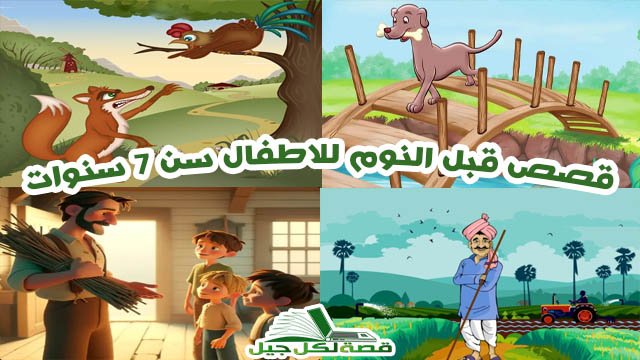
Salim the Dog and Rayan the Rooster explores friendship and a failed trick. A father's bundle of sticks illustrates cooperation, while a little dog's lost bone introduces contentment. Let us read together.
Read next: Bedtime Stories for Six-Year-Olds.
1. Salim the Dog and Rayan the Rooster
On a small farm lived Rayan, a red rooster, and Salim, a friendly gray dog. The inseparable friends decided to explore the wide forest and enjoy an adventure together.
They walked until evening, when their feet grew tired. Rayan noticed an old hollow tree. “I shall sleep on a high branch, and you can rest inside,” he suggested. Salim agreed, and they slept peacefully until morning.
At dawn, Rayan woke and crowed as usual. This time, his voice roused a cunning fox nearby. Opening his eyes eagerly, the fox thought, “That rooster will be my breakfast.”
“Hello, handsome Rooster! Come down and be my friend,” he called slyly. Remembering Salim's warnings about foxes, Rayan replied, “With pleasure. Come through the door at the bottom of the tree.”
The fox hurried toward the hollow trunk, imagining a delicious meal. Suddenly, Salim leaped out, barking fiercely. Terrified, the fox sprang away and fled into the forest.
Rayan laughed gratefully. “You saved me, Salim!” They continued happily, having seen how a trick could fail and how friends could protect one another in danger.
The lesson: Deception can backfire. Do not believe every flattering word. Loyal friends offer help when it is needed and stand by one another through difficulties.
2. The Little Dog and the Bone
One sunny morning, a little dog named Louay walked happily through the village. Passing the butcher's shop, he smelled meat and licked his lips at the sight of tasty bones.
The kind butcher smiled and tossed him one. “Here you are, little friend.” Louay caught it and hurried home, wagging his tail joyfully.
He crossed a small bridge over a large pond. Looking down, he saw his reflection and imagined another dog carrying a bigger bone.
“I want that one too!” he thought. Not realizing what he saw, he opened his mouth to seize it. His own bone dropped into the water and disappeared.
He jumped in to retrieve it, but was not a good swimmer. Kicking fearfully, he struggled to the bank and stood there wet and miserable, regretting his lost prize.
He went home slowly. Too late, he understood how greed could cost him what he already had. Afterward, he learned to appreciate his own good fortune.
The lesson: Wanting what seems to belong to someone else can make us lose sight of what we have. Contentment and gratitude can bring greater peace than greed.
3. The Father, His Sons, and the Sticks
A kind man named Salem had three sons and no daughters. His boys constantly argued and fought, giving their poor father a headache and little peace.
He repeatedly asked them to stop, but they would not listen. He considered how to teach them the value of cooperation and affection instead of hostility.
After one particularly quarrelsome day, his headache became unbearable. He called the boys and asked one to fetch a bundle of small sticks. When it arrived, he smiled at his plan.
He handed each son a single stick. “Try to break it.” The first two snapped theirs easily. The third laughed. “Easy as eating cake!”
Then he gave them the whole tied bundle. “Try now.” They pulled, pressed, and struck it, even trying to break it against the door. None could snap the bundled sticks.
“Do you see?” Salem asked. “When you support one another, you are strong like this bundle. Divided by arguments, you are like a single stick that breaks easily.”
The lesson: Cooperation gives strength, while constant quarrels weaken our support for one another. Affection and teamwork help build a happier family.
4. The Farmer and the Stuck Cart
Long ago, a farmer named Mahmoud drove a loaded cart along a country road after rain. Its wheels sank deep into mud, and the tired horses could not pull it free.
He climbed down and stared unhappily, without trying to push or help the horses. He complained about his bad luck and shouted for someone to assist him.
Suddenly, the strong hero Hercules appeared. Looking at the tired horses and sunken cart, he said, “Push from behind while your horses pull forward. Do more than complain!”
Mahmoud followed the advice. He pushed hard and encouraged his horses. Little by little, the cart moved, came free, and rolled along the road again.
Smiling on his seat, he considered the lesson: effort could help him face difficulty. From then on, he tried to act instead of merely complaining.
The lesson: Trying reveals what we may be able to achieve. Honest effort can create a way forward where complaints alone do not.
5. Rabah and the Golden Arrow
Long ago, brave Rabah and his loyal companions lived secretly in a dense forest, hiding from unjust rulers. They helped people in need with food and clothes against the winter cold.
The city's governor, Nasir al-Din, was greedy and merciless. He demanded money from people who already had very little. Rabah continually disrupted his plans, earning his anger.
Seeking a new trap, the governor consulted a learned friend. They decided on a great archery contest with a dazzling arrow of gold and silver as the prize.
The news reached the forest. “I shall compete and win that arrow from the governor himself,” Rabah laughed. He blew his horn to gather his friends beneath an old tree.
Among them was Jaber, a large, smiling man whom they jokingly called Little Jaber. “We can sell the prize and give the money to people who need firewood,” he said.
On the contest day, crowds filled the square. Rabah and five skilled companions entered, while others mingled among the spectators. A broad hood concealed Rabah's face.
Jaber and the others hit the target accurately. Then Rabah drew his bow and sent an arrow through the wood, splitting it in two. Everyone marveled at his skill.
The herald announced him as winner. Rabah approached the governor and raised the golden arrow with a smile. Suddenly, a horn sounded, and the governor's men rushed to arrest him.
Hundreds of Rabah's companions stepped from the crowd, aiming arrows at the soldiers. “You know we are the finest archers in the land!” Jaber called. Fear spread through the guards.
“I am afraid of arrows!” one soldier cried, fleeing. Others followed. The governor's face reddened. “I shall catch you next time, Rabah!” His friends laughed. “Look! He is red as a tomato!” Jaber teased.
The crowd joined in. The louder they laughed, the angrier the governor became. Rabah sold the arrow and shared the money so families could buy firewood and warm their homes through the long winter nights.
The story of the golden arrow was passed between generations as a tale of courage, justice, and loyalty. Rabah and his friends showed that true strength came from caring hearts and fair treatment, rather than precious metal.
The lesson: Justice and courage are worth more than treasure. Helping those in need and standing together against unfairness can give life meaning and leave a good memory behind.