
Bedtime stories
The Ant and the Grasshopper: A Fable about Planning Ahead
Nasheeta stores food while Masroor plays his violin. When winter comes, the grasshopper learns about preparation, balanced effort, and compassion.
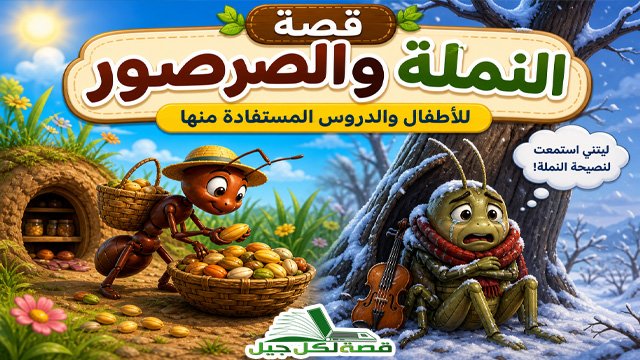
Welcome, friends of Qissaflow. Today we open another page of familiar fables with The Ant and the Grasshopper.
Simple in its events but rich in meaning, this tale has passed between generations to explore work, effort, and planning ahead. Let us visit a wide green meadow and see what happens.
The Ant and the Grasshopper
Summer was at its loveliest. Colorful flowers swayed in a gentle breeze, birds sang, and warm golden sunlight brightened the fields. Seeds, grain, and ripe fruit were plentiful.
A small ant named Nasheeta lived there. Her name suited her busy nature. Every dawn, she said goodbye to her family and joined long lines of ants gathering food. She carried heavy wheat grains and scattered biscuit crumbs through the hot sun, storing them carefully in her underground village.
Nearby lived Masroor the grasshopper. He had a little violin that made beautiful music. He disliked work and spent his days and nights hopping among leaves, singing, and enjoying the sunshine and abundant food.
One very hot day, Masroor sat beneath a large sunflower, playing happily. Nasheeta passed, sweating and dragging a yellow corn kernel twice her size. She breathed hard and moved slowly with exhaustion.
He stopped playing and looked at her mockingly.
“Hello, little Ant! Why make yourself suffer on such a lovely day? Food is everywhere. Leave that heavy kernel and sit in the shade. Let us sing and enjoy life!”
She paused, wiped her forehead, and answered seriously.
“I am collecting food for winter. It will come, and when snow covers this ground, there will be little to eat. You should prepare too, instead of spending all your time singing.”
Masroor laughed so loudly that his antennae shook.
“Winter? It is far away! Why worry about something that has not come? Let us enjoy today. There will be time to think of winter tomorrow.”
Nasheeta sighed, realizing she would not persuade him. She took up her kernel and continued toward home, while he returned to his music.
The days passed quickly. Summer departed, and autumn changed the meadow. Leaves turned yellow and orange and fell one by one. Cold winds announced harder days.
Nasheeta and her friends worked even harder, collecting the remaining seeds. Masroor began to feel chilly and needed longer to find food, but still spent his time hopping and singing, living on fallen leaves.
Then, overnight, a snowstorm swept through. By morning, the meadow wore a white coat. Snow covered trees, flowers, and the ground where seeds had been. Familiar landmarks vanished in the bitter cold.
In the warm underground village, Nasheeta sat peacefully with her family. Their stores held wheat and corn, and everyone enjoyed food, drink, and warmth: the result of their long summer's work.
Outside, Masroor shivered. His violin strings were frozen. He searched everywhere for a morsel, but snow covered it all. He could find neither a leaf to eat nor unfrozen water to drink.
Weak with hunger and cold, he nearly collapsed. Then he remembered Nasheeta's warning and how he had mocked her work in the summer sun.
Dragging his trembling body, he made his way to the ants' village. At its icy little door, he knocked weakly.
“Tap, tap, tap.”
Nasheeta heard and opened the door a little. There stood Masroor, pale and weak, his eyes full of tears and regret.
“Please help me, my friend,” he said faintly. “I am freezing and starving. I have eaten nothing for days. Could you spare some food and warmth?”
She looked at him reproachfully.
“Welcome, Masroor. Where are your lovely tunes and high jumps? While I worked in summer, you laughed and sang. What did you do through all those months?”
He bowed his head, a tear rolling over his cold cheek.
“I was foolish. I wasted my time and never thought ahead. I imagined summer would last forever. I have learned my lesson and promise not to be lazy. Please forgive me.”
Nasheeta was wise and kind. She wanted him to understand, but could not leave him to die of hunger and cold. Opening the door wide, she said:
“Come in and warm yourself by the fire. I shall bring food. But remember: effort bears fruit, and those who sow can reap. Singing and playing are lovely, but we must also complete our work and prepare for the future.”
He entered the warm home, ate until he was satisfied, and thanked her wholeheartedly for her generosity and compassion.
The following summer, Masroor was among the first awake to gather food. He worked beside the ants and sometimes sang during their breaks. He had discovered how effort and enjoyment could belong together.
Read next: The Lion and the Mouse.
Lessons from The Ant and the Grasshopper
This fable offers several ideas for children and adults to discuss:
- Effort matters. The ants work to meet their needs rather than relying entirely on luck or plentiful circumstances.
- Prepare for change. Good times can make us forget harder ones. Saving and planning ahead can help when circumstances change.
- Do not keep postponing responsibilities. Masroor's repeated delays leave him unprepared when winter arrives.
- Balance work and enjoyment. The story does not reject music or play. Masroor still sings, but learns to make room for his responsibilities too.
- Show compassion and allow another chance. Nasheeta helps her regretful neighbor instead of taking pleasure in his suffering.